04 · tool · AI film pipeline
Cinema studio
You prompt a film, you get one frame, and you can never get it back. No recipe, no cost, no second take.
Direct your film instead of prompting it: every take keeps the recipe that makes it again, a year later.
- Project, shots, renders and edit, one place
- The director’s chat fills your shot sheet
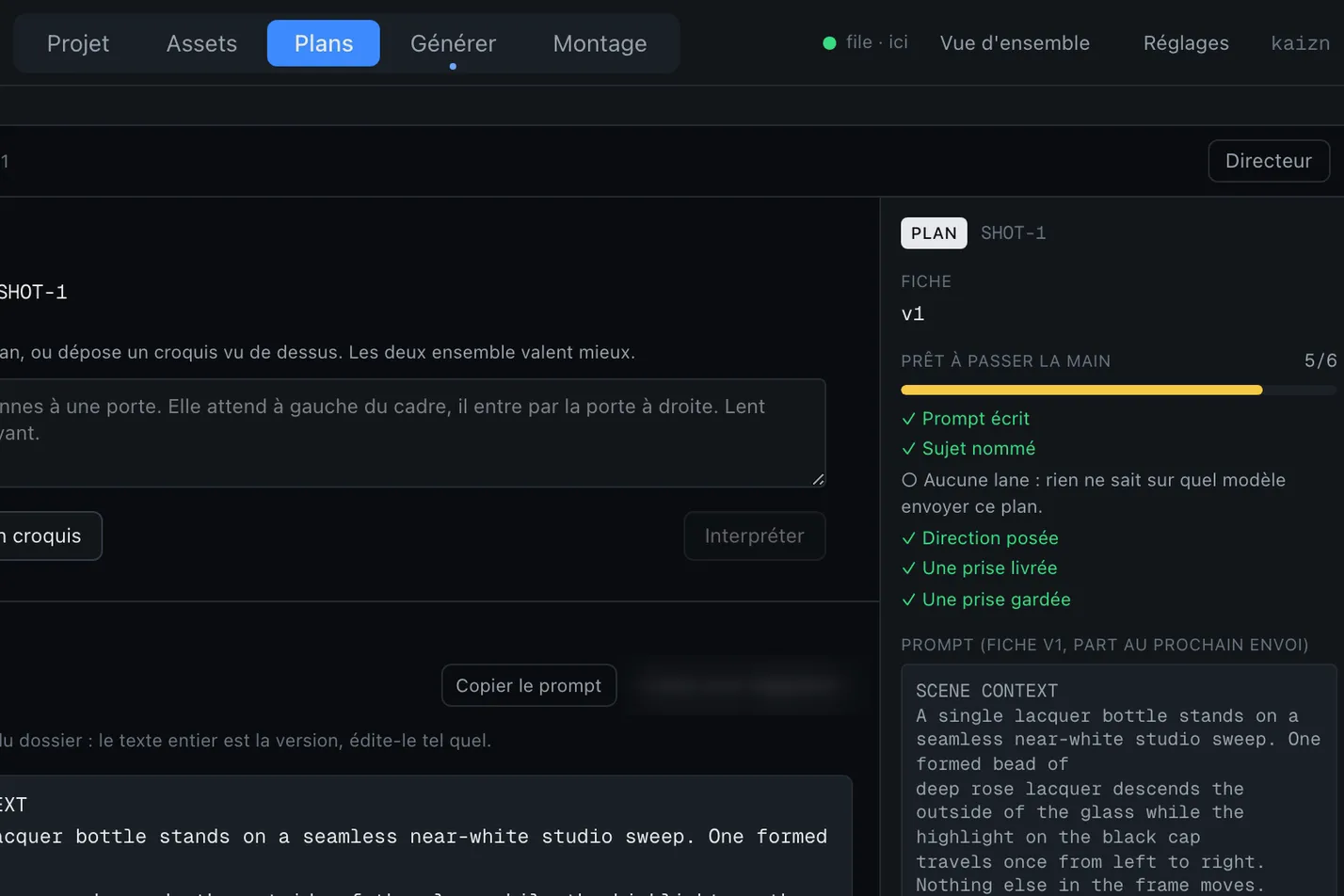
- One sheet per shot: context, renders, progress
The rules live in a file the pipeline reads, and a rule with no source is deleted, not softened.
01
What it does today
Today the engine takes one shot from idea to finished take. The project keeps its own material, four assistants write instead of generating, every shot has a sheet, and nothing missing is rounded into a guess.
The project keeps its material
Characters, locations, props, edits, prompts and production renders each have their own shelf. Bring in a reference, file it in the project library, tag it, and the next shot finds it again.
Four assistants, none generates
One turns a scene into a prompt you can copy, one cuts a told story into a scene-by-scene breakdown. One asks its questions and writes the shot spec, one draws a storyboard image per scene. None of them renders: that stays your click on Generate.
Every shot is a sheet
The sheet holds the scene, the list of what is still missing, and every take. What is missing is named, not guessed: a shot with no engine reads “nothing knows which model to send this shot to.”
Every take carries its cost
You see the engine that rendered it, the cost, marked an estimate until the provider has answered, the duration, the resolution and the service that actually ran it. You keep it or you reject it, and that verdict files the take.
An AI notice that cannot vanish
Every conversation opens on the disclosure the AI Act requires. It is the first message of the thread itself, not a footnote a later redesign could drop.
How a take replays
Either bit for bit, when the model accepts a seed, or by its record: the request replays exactly, the clip itself may differ. Which one applies is computed and written into the take when it is made, never guessed afterwards.
02
How it works
One shot at a time, from the idea to the gallery. A question you skip stays a stated absence, never a default someone invented.
- 01
Idea or script
A scene in plain language, or a whole script the assistant cuts into a breakdown, ordered by priority.
- 02
Shot sheet
The director asks one question at a time: subject, camera, light, motion. Leave one empty and it stays empty and stated, never filled with a default.
- 03
Engine and prompt
The engine you pick decides the language of the prompt, and the shot compiles into the exact vocabulary that model expects.
- 04
Take
The take goes out as a draft or a finish, and comes back with its cost, its duration, its resolution and the service that actually ran it.
- 05
Gallery
Every take lands in the project gallery, on its shelf, carrying your verdict: kept or rejected.
03
How it grows
V1 is the spine: one shot, start to finish. What the roadmap names next is a memory that carries from one shot to the next.
V1 · one shot, start to finish
An idea or a breakdown, a shot sheet written by the director, a take with its recipe and its cost, your verdict, and an AI notice in every thread.
Next · locked elements and sequences
Then characters, locations and props get versioned and locked, bound to the scenes that need them, and several shots chain into one assembled sequence.